KU aerospace engineering student wins first place in international aircraft design competition
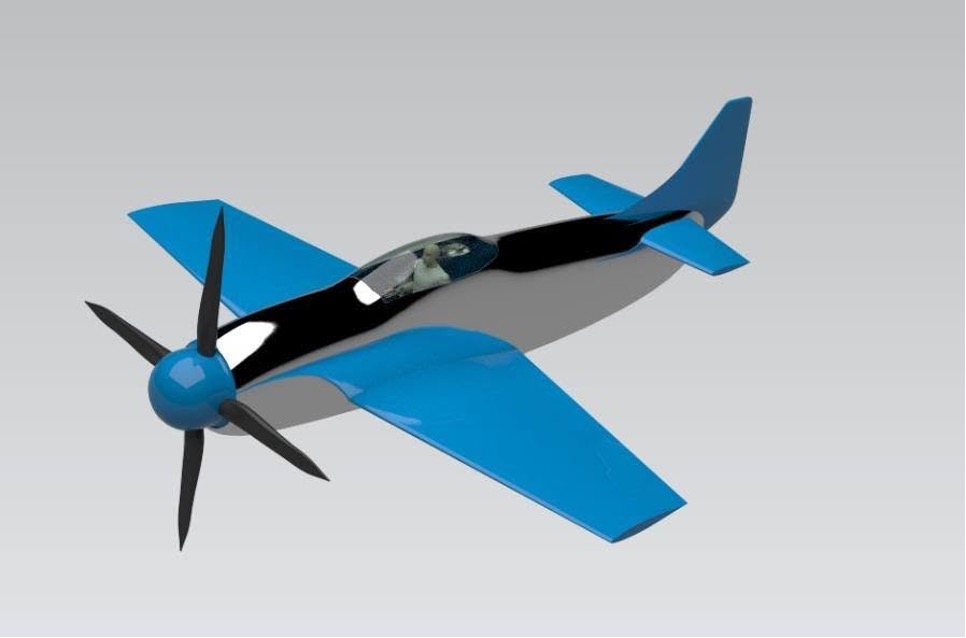
LAWRENCE — University of Kansas School of Engineering student Thomas Baker has won first place in the American Institute of Aeronautics and Astronautics (AIAA) 2025-2026 Aircraft Design Competition.
Baker designed the “XP-1 Renegade,” an unlimited-class air racer projected to fly faster than 500 miles per hour in events such as the National Championship Air Races. Judges praised Baker for his outstanding performance analysis, grasp of dynamic lift manipulation and overall quality.
“Well done! Fine work of aeronautical science,” one judge wrote.
Baker was coached by Willem Anemaat, professor of the practice in aerospace engineering and president of DARcorporation in Lawrence.
“Mr. Baker went way beyond the original design requirements and intent and wrote his own simulation to verify and improve the performance of the racer,” Anemaat said.
Baker, the son of Robert and Julie Baker of Overland Park, is a second lieutenant on active duty in the U.S. Air Force. He is stationed at Vance Air Force Base in Enid, Oklahoma, and begins pilot training in November.
AIAA design competitions are the oldest and largest of their kind in the world. For more than a half-century, they have drawn entrants from more than 150 institutions worldwide.
Baker’s win is the KU Department of Aerospace Engineering’s 109th major aerospace design award and its 46th first-place finish since KU first entered AIAA competitions in 1976.
This win also marks a milestone for the department. Fifty years ago, the late Distinguished Professor Jan Roskam, founder of KU’s aircraft design program, coached his first winning team in this same competition.
Many of Roskam’s former students, including Anemaat, now coach award-winning students of their own. Over the past half-century, more than 400 KU students have contributed to these award-winning designs, and many have gone on to highly distinguished aerospace careers.
Ron Barrett-Gonzalez, KU professor of aerospace engineering, has overseen the award-winning projects of hundreds of students.
“We harness the power of departments and disciplines across our multifaceted university to give us an edge over the best monolithic technical institutions around the world. Students and faculty from entomology, paleontology, business, law, and architecture and design have all helped us capture top spots through the years,” Barrett-Gonzalez said.
The Department of Aerospace Engineering and its aircraft design program directly support Kansas’ largest manufacturing industry by maintaining high standards of rigor and excellence in technical education. According to the Aerospace Industries Association, the industry employs just over 100,000 Kansans and accounts for roughly 8.5% of the state’s GDP. Each year, it generates $10.8 billion in wages, $36.4 billion in economic output and $1.5 billion in state and local tax revenue.