America’s Cold War strategy examined in new handbook of military history
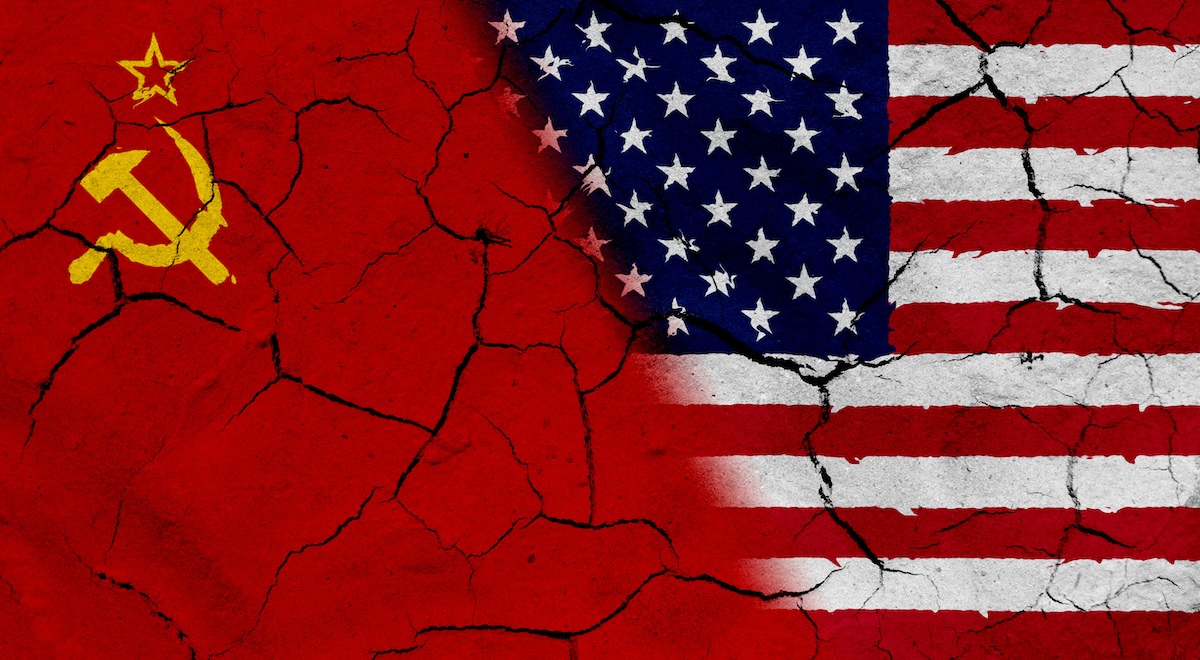
LAWRENCE — The biggest misunderstanding about the Cold War is to assume it’s over, according to Adrian Lewis, the David B. Pittaway Professor in Military History at the University of Kansas.
“Anybody who’s paying attention today would realize we’re in Cold War 2.0. Some would say it never really ended. It’s just that now the major power is not the Soviet Union but the People’s Republic of China,” he said.
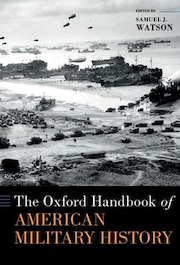
Lewis’ views on this volatile era — a period from 1947 to 1991 during which the United States, Soviet Union and their allies amassed a nuclear arsenal which threatened mutually assured destruction — are found in a chapter titled “The Cold War” that appears in “The Oxford Handbook of American Military History.”

The book is published by Oxford Academic.
Lewis said the Cold War was an inevitable consequence of World War II.
“No matter who you want to argue as the aggressor or cause of the Cold War, two superpowers emerged from World War II. But the Soviet Union had 25 to 30 million casualties. They had high security needs. They were suffering from post-traumatic stress disorder on a national scale — a scale Americans can’t imagine,” he said.
Despite this escalating power struggle, a miracle occurred that few predicted.
“The most important thing about this era is what did not happen: There was no nuclear war,” Lewis said. “If you look at human history, wars were becoming more and more total. World War I and World War II killed 70 million people. Then you create nuclear weapons that have the ability to exterminate life on planet Earth … but instead of using them, we go back to limited war. The miracle is what did not take place.”
When researching the Cold War era, Lewis said he was shocked at the amount of what he considers “overkill” regarding how both sides operated. By 1986, both sides had stockpiled a combined 50,000 nuclear warheads.
He asked, “How many times over do you need to be able to destroy the world?”
Numerous leaders came and went during the period, each bringing their own adjustments to the strategy of containment. But Lewis points to two U.S. presidents who best navigated the Cold War.
“I pick Truman and Eisenhower,” he said.
“During the Korean War, there were calls to use nuclear weapons. But Truman didn’t do it. Think about that. Here’s the man who used them in Hiroshima and Nagasaki. Now he’s saying no to them. Truman came to realize this is not just a bigger bomb; this is something that can destroy human life on the planet. Credit goes to Truman for what he did not do. His actions created artificial limited war.”
The professor also praises Eisenhower for developing and instituting the nuclear triad system (land-based intercontinental ballistic missiles, submarine-launched ballistic missiles and strategic bombers) that kept the enemy in check.
Lewis said, “Eisenhower spent the money on the triad. Although it seems like he regretted it, what with his last speech discussing the ‘military industrial complex.’”
Now in his 17th year at KU, Lewis has written books that include “Omaha Beach: A Flawed Victory,” “The American Culture of War: The History of the U.S. Military Forces from World War II to Operation Enduring Freedom” and “The American Culture of War in the Age of Artificial Limited War.” The Chicago native is currently working on a book about the history of African Americans in U.S. armed forces.
He retired from the Army after serving with the 9th Infantry Division and the 2nd Ranger Battalion.
Did anybody actually win the Cold War?
“Humanity … at least to this point,” Lewis said.
“In the essay, I say that the most important thing didn’t happen. They didn’t use nuclear weapons. They downsized. But the U.S. and Russia still maintain enormous nuclear arsenals right now, and the Chinese have decided to match us. We still live in a very dangerous world.”