Christian nationalists more likely to oppose gun regulations and support political violence, study finds
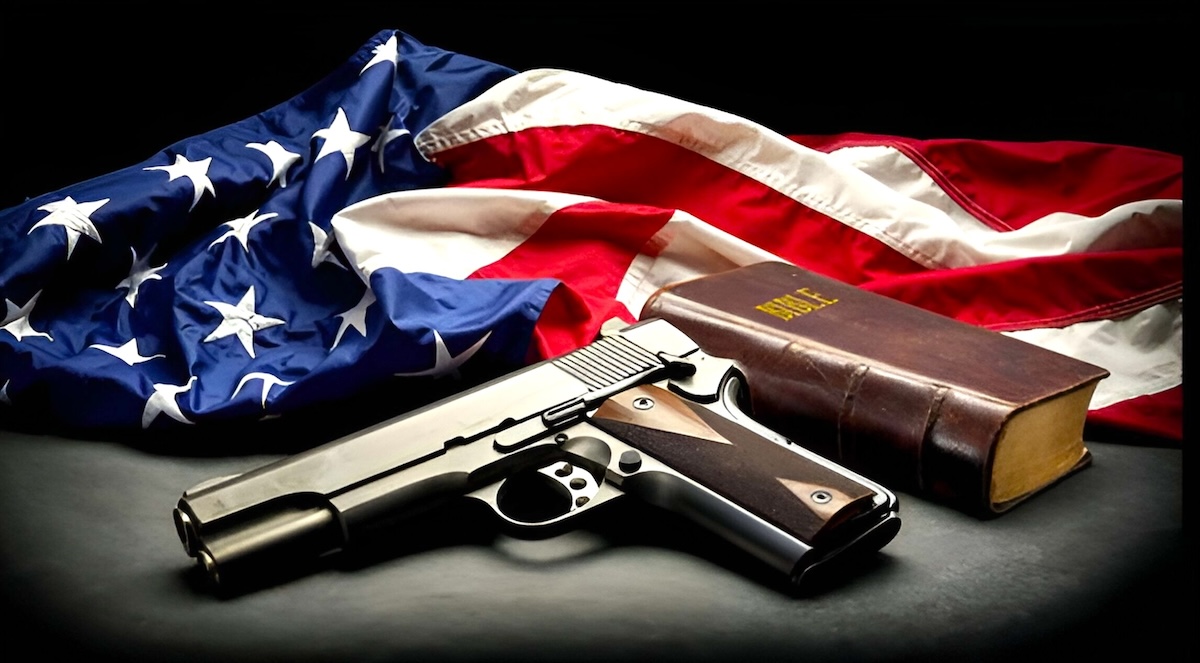
LAWRENCE — The most unifying issue among Christian nationalists used to be abortion. But according to new research, guns may now be the most important issue.
“Even amongst Christian nationalists who don’t own guns themselves, what we find is they definitely see gun owners as part of their in-group and are far more opposed to gun regulations than the typical non gun owner,” said Don Haider-Markel, a professor of political science at the University of Kansas.
But his article titled “An Army for God: Gun Ownership, Christian Nationalism, and Support for Political Violence” reveals another connection: It finds that for Christian nationalists with a high gun-owner identity, there is an instilled culture of personal and community protection that makes them more likely to endorse extreme actions like violence. The article appears in Social Science Quarterly.

“We’re observing the fusion and overlapping of identities between Christian nationalism, gun ownership and gun-owner identity,” said Haider-Markel, who co-wrote the article with Brooklyn Walker of the University of Tennessee and Abigail Vegter of William Jewell College (Missouri).
“With that fusion, the most important aspect of our research is that there is an interaction between Christian nationalism and gun ownership — especially strong-identity gun owners — that makes support for political violence even higher than it is with each of those alone.”
According to a study by the Public Religion Research Institute (PRRI) released this year, approximately 70 million to 80 million Americans consider themselves Christian nationalists. In order for Haider-Markel’s team to test the hypotheses, the researchers used a nationally representative sample of American adults (1,459 subjects) recruited by Dynata to participate in an online study in 2021.
They found that even when controlling for a variety of demographic, religious and political factors, gun owners are more likely to score high on Christian nationalism, and Christian nationalists are more likely to be gun owners and have a strong gun-owner identity. Additionally, Christian nationalists, gun owners and gun identifiers are more likely to support political violence.
Haider-Markel said he was motivated to pursue this area of research following the Jan. 6 insurrection.
“The fact that so many prominent actors in those events — even those who didn’t go into the Capitol — were Christian nationalists and increasingly identified as such was just hard to ignore. Beyond the role played by groups like the Proud Boys and the Oath Keepers, these Christian nationalists were seemingly advocating for violence against the vice president and members of Congress,” he said.
The professor notes that many surveys have asked about gun-owner identity or how important this identity is to a person. But his team’s survey was unique in finding the interaction between Christian nationalists and gun ownership, and especially an interaction between Christian nationalism and having a gun-owner identity.
“That was something I didn’t fully expect,” he said. “It stood out how much more gun-owner ‘identity’ mattered than even simply owning a gun.”
Now in his 29th year at KU, Haider-Markel has done extensive studies in gun-related topics, criminal justice, policing and LGBTQ rights. His recent article titled “Fear and Loathing: How Demographic Change Affects Support for Christian Nationalism” suggests exposure to religious demographic change shifts support for Christian nationalism and perceptions of discrimination against whites and Christians.
Haider-Markel’s research has found that modern Christianity in the U.S. cannot be divorced from politics.
“It’s been a very long time since we can separate evangelical Christians from politics because it’s become such an important part of the Republican coalition. In many ways, the Republican Party doesn’t exist without it,” he said.
If that’s the case, then what will Christianity look like in the U.S. two decades from now?
“The answer to that question really depends on what happens with Christian nationalism,” Haider-Markel said. “Lots of observers see Christian nationalism as a threat to not only democracy but also to Christianity itself. That’s because it’s purporting a worldview that is actually antithetical to the teachings of Christ and what’s in the Bible.”