Director brings urgency to production of ‘Silent Sky’
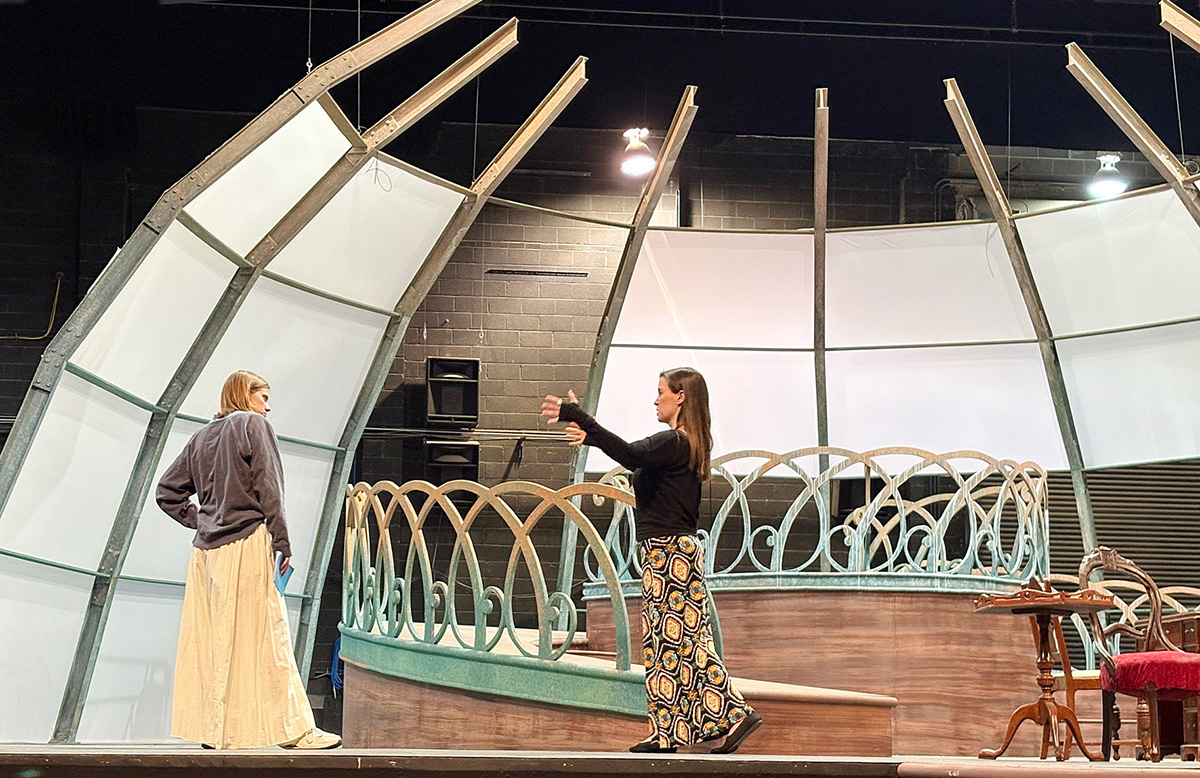
LAWRENCE — Actor, singer, director and producer Michelle Miller finds herself drawn to science, and that is serving her well as she directs the University of Kansas Department of Theatre & Dance production of Lauren Gunderson’s “Silent Sky.”
The play about pioneering woman astronomer Henrietta Swan Leavitt runs Oct. 3-5 in the Crafton-Preyer Theatre.
For instance, long before Miller signed up for “Silent Sky,” she listened to books by astrophysicists Brian Cox and Charity Woodrum.
“I often fall asleep at night listening to astronomers,” she said. “It gives me a tremendous sense of calm. There can be chaos down here, but there’s order somewhere. There’s gravitational pull. There are black holes. Stars are dying and rejuvenating. There’s something that I find comforting about space, whereas other people find dread.”
Now a full-time lecturer at KU, Miller brought in Allison Kirkpatrick, associate professor in KU’s Department of Physics & Astronomy, to talk with the “Silent Sky” cast and crew about the historic struggles of women in the field against sexism, as well as Kirkpatrick’s own experience of it.
Miller said the effect on the company was “alchemical, because it grounded it in the reality of the injustice — injustices that still occur today — and suddenly they were fired up.”
Given that Kirkpatrick has run surveys using the James Webb Space Telescope, her visit drew a connection between the play’s action — from the 1890s to Leavitt’s death in 1921 — and today.
“Leavitt’s big discovery gave us a standard by which calculations could be made as to the distance of stars,” Miller said. “So without her, we don’t have the men for whom today’s space telescopes are named — Edwin Hubble and James Webb. We do not have the moon landing. We don’t have any of our leaps forward in space. And she was paid 25 cents a week and never allowed to use the great refractor telescope ... because they didn’t want women to be there overnight, because it was improper and they could be corrupted.”
Even though “Silent Sky” is 10 years old and concerns events more than a century ago, Miller said, “What I think about is how modern this play feels. The play is meeting the moment of where we are in our country and what’s happening with science and the arts and women’s roles in moving things forward.
“I keep saying that science shows us the mechanics of the universe and where we are in it, and the arts show us the meaning and the why,” Miller said. “Those two things working together — congruent pursuits of wonder — are really powerful. That’s why there’s an urgency to this story.”