Kansas science teachers to take part in immersive program at KU Field Station
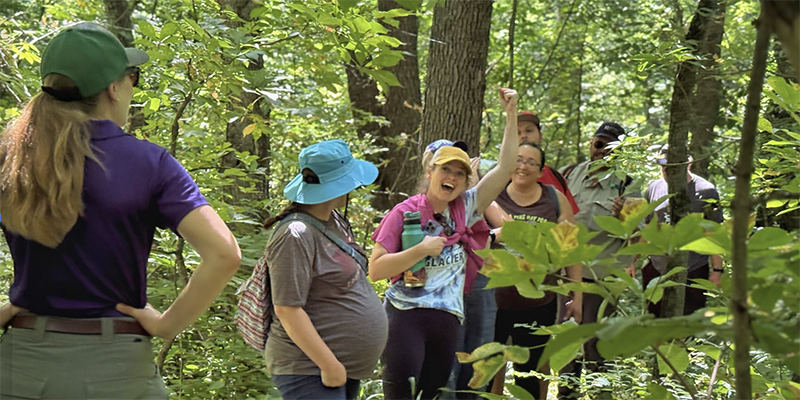
LAWRENCE — Ten secondary school science teachers from Kansas will converge this week at the University of Kansas Field Station, just north of Lawrence. They’ll take part in the Ecosystems of Kansas Summer Institute, an annual immersive program that gives secondary educators the chance to work with KU scientists to explore resources and gain new ideas for their classrooms.
“I’m passionate about helping students see science as a process for understanding the world, not just a set of facts to memorize,” said Jackson Dinsmore, a teacher at Blue Valley North High School in Olathe and a 2026 participant.
“As I’ve started incorporating more field biology, I wanted to deepen my understanding of Kansas ecosystems so I can create more meaningful, hands-on learning experiences. I’m excited to learn from researchers and other educators to bring back ideas that help my students connect with the natural world.”
The teachers are the eighth group to take part in the Summer Institute, a program of the Kansas Biological Survey & Center for Ecological Research, which manages the Field Station. The event runs June 2-5.
Guided by KU researchers, the teachers will participate in hands-on, Next Generation Science Standards (NGSS)-aligned activities. They will focus on Kansas ecosystems: streams, prairies and woodlands. They’ll visit field sites each morning, including the KU Field Station’s Rockefeller Native Prairie and a stream near the Field Station’s core research area. They will return to the Field Station’s Armitage Education Center during the afternoons to work indoors.
Activities will include:
- Working with researchers on boats at the KU Field Station’s Cross Reservoir
- Exploring the KU Field Station’s Baldwin Woods Forest Preserve
- Visiting prairies and learning about native plants, pollinators and more
- Investigating relationships among soils, microbes and prairie plants
- Learning about stream ecology
- Engaging with The Virtual Field and other resources that can help to connect students with ecosystems.
The Summer Institute was created by Peggy Schultz, a researcher at the Kansas Biological Survey & Center for Ecological Research and a faculty member in KU’s Environmental Studies Program. She developed the program as an outreach component of a National Science Foundation research grant, which funded the program for five years.
The program continues through support from donors to the Kansas Biological Survey's Friends of the KU Field Station Fund at KU Endowment. The Summer Institute is organized and led by Wendy Holman, education program coordinator for the KU Field Station and a former middle school science teacher.
Participants in the program are selected through an application process, with information available on the website of the Kansas Biological Survey & Center for Ecological Research.
Teachers participating this year shared their reasons for applying.
“I care deeply about native Kansas ecosystems and think it is important to expose and educate my students to them,” said Sara Abeita, a teacher at Free State High School in Lawrence. “I hope to gain new connections with other like-minded teachers to bring high-quality inquiry and outdoor-based instruction to my students.”
Jackson Alex, of Spring Hill High School in Spring Hill, said, “A colleague of mine referred me to the program as I've just introduced AP Environmental Science to my own high school. The rabbit hole of research and learning about a wide range of topics that I've been required to do to be able to teach this course has made me realize how much I don't know about ecosystems. I felt the best place to start expanding my knowledge would be in my own backyard.”
Teachers participating in the 2026 Summer Institute, all from Kansas, are:
- Sara Abeita, Free State High School, Lawrence
- Jackson Alex, Spring Hill High School, Spring Hill
- Brian Batchelder, Baldwin Junior High School; Baldwin City
- Brooke Belcher, Blue Valley Northwest High School, Overland Park
- Jackson Dinsmore, Blue Valley North High School, Overland Park
- Marci Handley, Oregon Trail Middle School, Olathe
- Brook Martinez, Landon Middle School, Topeka
- Nick Pierce, Mill Creek Middle School, Lenexa
- Logan Swank, Olathe Northwest High School, Olathe
- Gabe Younger, Pleasant Ridge High School, Easton.
Among the participating instructors, nearly all based at the Kansas Biological Survey & Center for Ecological Research, are:
- Sara Baer, director of the Biological Survey and a senior scientist, and KU professor of ecology and evolutionary biology;
- Debbie Baker, an aquatics researcher at the Biological Survey;
- Ashley Bowman, a prairie plant communities ecologist and lab manager at the Biological Survey;
- Christine Cornish, a researcher in the Biological Survey’s Lake Assessment Lab;
- Craig Freeman, a senior scientist at the Biological Survey and senior curator of KU’s R.L. McGregor Herbarium;
- Ted Harris, and associate research professor at the Biological Survey and head of the Lake Assessment Lab;
- E.J. Jamison, northeast district forester for the Kansas Forest Service;
- Cailin Kessen, KU graduate student in the Monarch Watch lab, which is housed at the Biological Survey;
- Liz Koziol, an assistant research professor at the Biological Survey and an associate curator of the International Collection of Vesicular Arbuscular Mycorrhizal Fungi (INVAM), which is housed at KU’s West District Greenhouse;
- Terra Lubin, a researcher and an associate curator of the INVAM collection;
- Tom McKenna, an assistant research professor at the Biological Survey;
- Caleb Morse, senior collection manager at KU’s R.L. McGregor Herbarium
- Sheena Parsons, manager of the KU Field Station
- Dana Peterson, a GIS/earth observation researcher in the Kansas Applied Remote Sensing Program at the Kansas Biological Survey;
- Peggy Schultz, founder of the Summer Research Institute.
The Kansas Biological Survey & Center for Ecological Research, a KU designated research center, houses a diverse group of ecological research and remote sensing/GIS programs in KU’s West District in Takeru Higuchi Hall, the Smissman Laboratories building and the West District Greenhouse. The research center also manages the 3,200-acre KU Field Station, a site for study in the sciences, arts and humanities.