KU recognizes researchers improving cancer treatments, developing advanced electronics and exploring galaxies
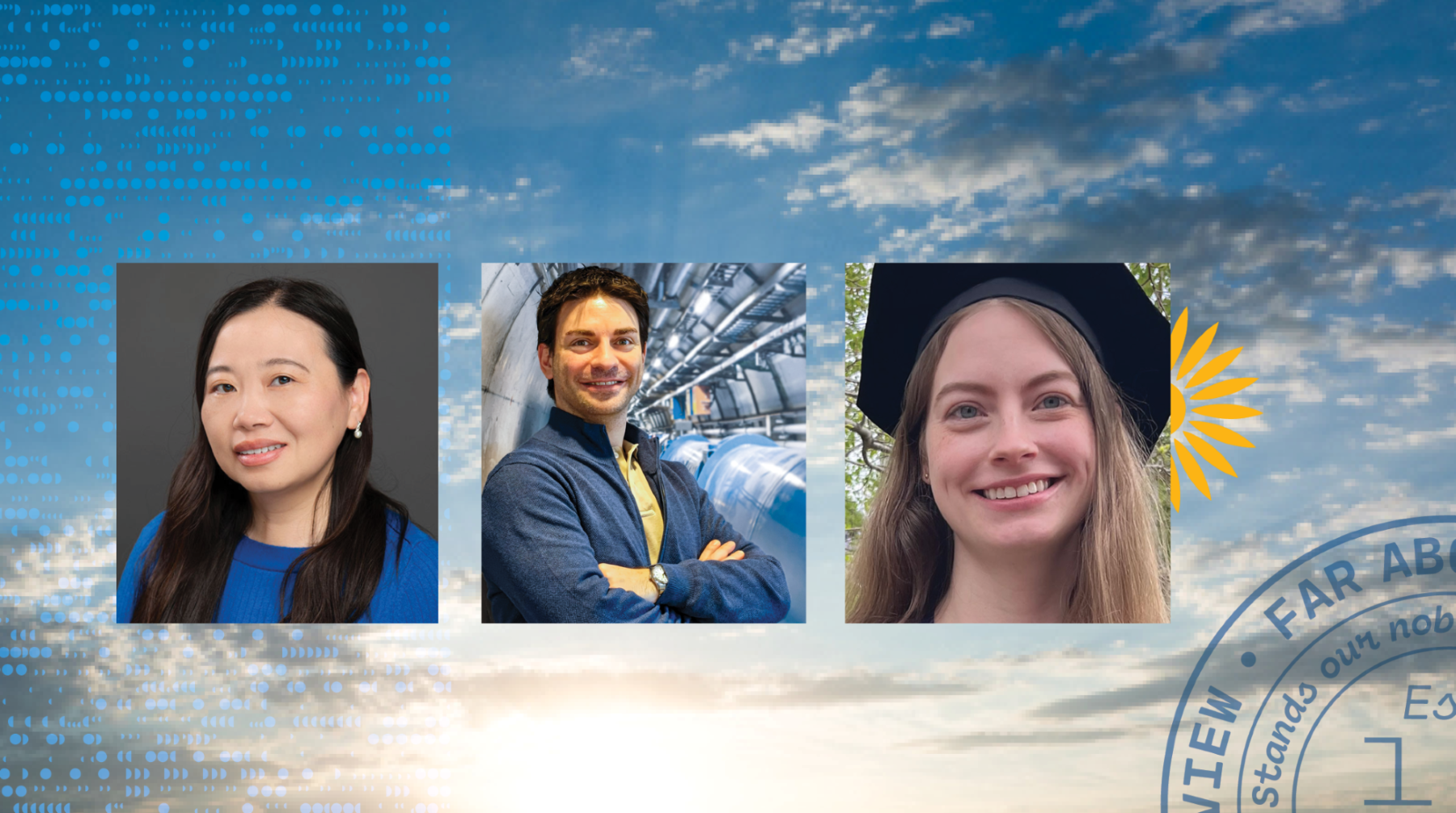
LAWRENCE — University of Kansas researchers expanding the understanding of molecular cancer therapy, highly sensitive electronics and active galactic nuclei have received this year’s Steven F. Warren Research Achievement Award and the KU Research Staff & Postdoctoral achievement awards.
The annual awards recognize outstanding unclassified academic staff, unclassified professional staff and postdoctoral fellows whose research has significantly influenced their fields and expanded intellectual or societal insights. This year’s recipients:
- Xiaoqing Wu, associate research professor, Department of Molecular Biosciences, Steven F. Warren Research Achievement Award
- Nicola Minafra, research scientist, Department of Physics & Astronomy, KU Research Staff Achievement Award
- Bren Backhaus, postdoctoral researcher, Department of Physics & Astronomy, KU Research Postdoctoral Achievement Award.
The three will be recognized at a ceremony this spring along with recipients of other major KU research awards.
The Office of Research established the Steven F. Warren Research Achievement Award in 2006 to honor unclassified academic staff researchers. Winners receive $10,000 in research funds. The KU Research Staff & Postdoctoral achievement awards were established in 2018, with honorees receiving $5,000 for approved research or professional development activities.
Xiaoqing Wu
Xiaoqing Wu is an associate research professor in the Department of Molecular Biosciences. Her work focuses on developing new cancer therapies by targeting three RNA-binding proteins known to play key roles in tumor growth: HuR, Musashi-1 and Musashi-2.
Wu joined KU in 2012 as a postdoctoral researcher in the laboratory of Liang Xu, professor of molecular biosciences. During her postdoctoral training, she used high-throughput screening — a technique that lets scientists quickly test thousands of potential drug compounds — to study cancer cells. This approach led to several promising discoveries. She earned a prestigious Kansas IDeA Network of Biomedical Research Excellence/National Institutes of Health Postdoctoral Award to continue validating her results.
After her promotion to assistant research professor, Wu received further support for her research on HuR from a Komen Foundation Career Catalyst Research Grant and a Department of Defense Prostate Cancer Research Program Idea Development Award. Wu has published 38 scientific papers over the past decade and is a co-inventor on three patents for new types of RNA-binding protein inhibitors.
Wu’s research has also strengthened other scientific projects. Her studies on HuR helped collaborators secure major grants to investigate liver, heart, lung and kidney diseases, with Wu serving as co-investigator on several of those awards. She also co-directs two KU core laboratories — the Experimental Imaging Core and the Biological Irradiation Core — where she supports KU researchers as well as outside academic and industry users.
She earned her bachelor’s degree in pharmaceutical engineering from Southeast University in Nanjing, China, in 2005, and her doctorate in medicinal chemistry in 2010 through a joint training program between Southeast University and the University of Michigan.
Nicola Minafra
Nicola Minafra is a research scientist in the Department of Physics & Astronomy. He designs highly sensitive equipment that helps scientists better understand how the universe works.
Minafra came to KU in 2016 as a postdoctoral researcher in Christophe Royon’s lab. Two years later, he became an adjunct researcher in the same lab, and in 2023, he joined the research group led by Daniel Tapia Takaki. During his time at KU, Minafra has made several important contributions, including designing proton detectors with record-breaking time resolution and developing advanced calorimetry for the Large Hadron Collider at the European Organization for Nuclear Research, known as CERN. These technologies make it possible for scientists to perform extremely precise measurements that investigate parts of the Standard Model that are still not well understood.
Minafra co-developed a patent for fast-timing electronics and contributed to the design of the Advanced Energetic Ion Electron Telescope, a NASA-funded detector designed at KU. He was recently appointed technical coordinator for the ALICE Forward Calorimeter, one of the most competitive and respected technical leadership roles at CERN, which is the world’s largest particle physics laboratory.
Minafra earned two degrees in physics — his bachelor’s in 2009 and his doctorate in 2016 — from the University of Bari Aldo Moro in Italy.
Bren Backhaus
Bren Backhaus is a postdoctoral researcher in the Department of Physics & Astronomy. She studies active galactic nuclei (AGN) — regions at the centers of galaxies where supermassive black holes are actively pulling in surrounding material and growing.
Backhaus joined KU in May 2024 and has already made several important contributions to her field. Growing supermassive black holes are often surrounded by thick clouds of dust that block much of their light, making them difficult to detect. However, this “hidden” phase is crucial for understanding how galaxies evolve. Using imaging from the James Webb Space Telescope, Backhaus created a photometric catalog that measures the brightness of galaxies across different wavelengths. These measurements help identify AGN during this obscured stage. She is also using this data to measure how many star-forming galaxies existed when the universe was about half its current age.
Prior to joining KU, Backhaus’ research also led to significant discoveries. She was among the first to show that high-energy emission lines — such as those from doubly ionized neon — can reliably distinguish between galaxies undergoing normal star formation and those hosting an AGN. Her pioneering techniques will help scientists uncover previously overlooked types of galaxies in the distant universe.
Backhaus earned her bachelor’s degree in physics from the University of Massachusetts in 2018 and her doctorate in physics from the University of Connecticut in 2024.