New book examines how educational reforms have attempted to fix past problems instead of inventing the future
LAWRENCE — For decades, the consensus has been that American education is not good enough, students are falling behind and society needs to do something to improve schools. But countless efforts at reform and millions in investments have not resulted in better education. In a new book, a University of Kansas scholar argues that is because leaders are trying to fix the problems of the past for all students instead of finding a new way forward for each individual.
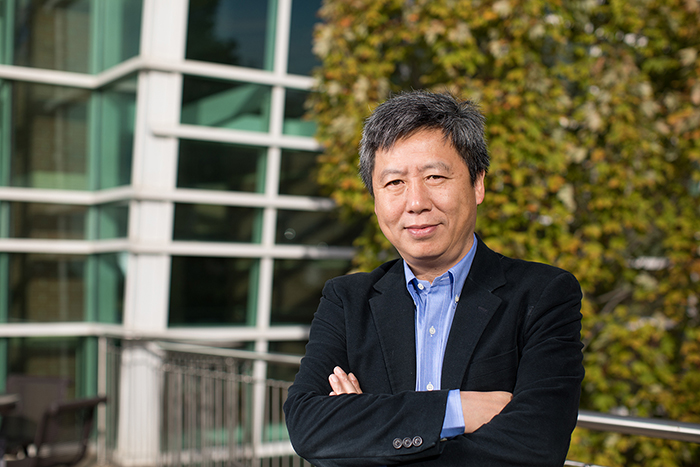
“Fix the Past or Invent the Future: Moving Beyond One-Size-Fits-All Education” by Yong Zhao, Foundation Distinguished Professor in the KU School of Education & Human Sciences, details the problems with reform efforts and how each individual has the power, not to mention the technology, to help students find and solve problems for the betterment of the world.
“The basic argument is this: Education has been trying to improve for a long time. People say education should be better. Everybody is complaining and we’re investing so much in reform, but why haven’t schools improved? I said, ‘I’m going to try to explain why improvement hasn’t happened. First, any improvement hasn’t been about meeting the needs of the individual student. Each classroom features a real child, not a probability. Our society seems to be intent on applying the same approach to all children.”
The book features two parts of five chapters each. In part one, “Fix the Past,” Zhao focuses first on the issue of probability. Research in the field looks for ways to find solutions, interventions, approaches and methods to better reach students. The studies are widely accepted by educators, policymakers and others, who often fail to realize that probability is not certainty and that even if a given approach works for some students, it inevitably will not work for others.
Further, Zhao provides detailed analysis of how efforts at improvement such as the growth mindset and social-emotional learning can result in stubbornness and fail to solve students’ emotional problems at school.
Finishing part one, Zhao points out how artificial intelligence is often viewed as either a threat or an opportunity to education. If applied in the current paradigm, AI would fail to solve any problems, as it would be applying new technology to the old educational paradigm, he wrote.
In part two, “Invent the Future,” Zhao illustrates how society is at a moment of opportunity to finally make real improvements to how young people are educated. While some may view AI as a shortcut or way for students to not do their own work, it can be a way for students and educators to customize education to each individual.
“Personalized learning follows an individual’s strengths and passions. I describe how that can be done with AI,” Zhao said. “I also look at how you can use it to find and solve problems that are helpful to society. People cannot continue to compete with each other using the same set of outdated skills, but that is what our system is doing. We should focus on each person’s strengths.”
In following chapters, the author elaborates on how schools, teachers and individuals can move from teaching known answers to known problems to develop the future-facing skill of identifying new issues and how to solve them, one of the most necessary skills future citizens will need. Such an approach could grow beyond the classroom to help establish human interdependence and shift away from the myth of meritocracy, Zhao wrote.
Last, the book acknowledges that reform efforts have largely failed, which can understandably leave people feeling defeated, or that new attempts by those in power will also fail. But one needs not wait for the traditional methods of reform to catch up, and Zhao leaves readers with a message of inspiration on how each student, educator and community member can make changes without waiting for larger, societal shifts. Students, teachers and others willing to personalize learning can start by forming a “school within a school,” wherein new approaches outside of the traditional approach are accepted.
The final chapter points out how anyone interested, be it just a few educators, students or parents, can start the reform themselves.
“The message of the book is, ‘Can we imagine a new future for education?' Right now it’s about curriculum, standards and assessment,” Zhao said. “I think we should break out of that and ask about each child. What are you good at, or what do you want to be good at? Then look at resources like family, AI, community and what is unique to each setting to find and solve problems that matter.”
As a young man, Zhao would often get carsick on bus rides. Riding along while others steer where educational reform goes can leave teachers, students and families feeling unwell. The answer is to become the driver, he said.
“I learned the driver never gets carsick,” Zhao said. “You want to be the driver of change. Change comes from you, and we can’t encourage others to change without changing ourselves.