Pioneering book aims to uplift Nigerian Hausa Muslim women
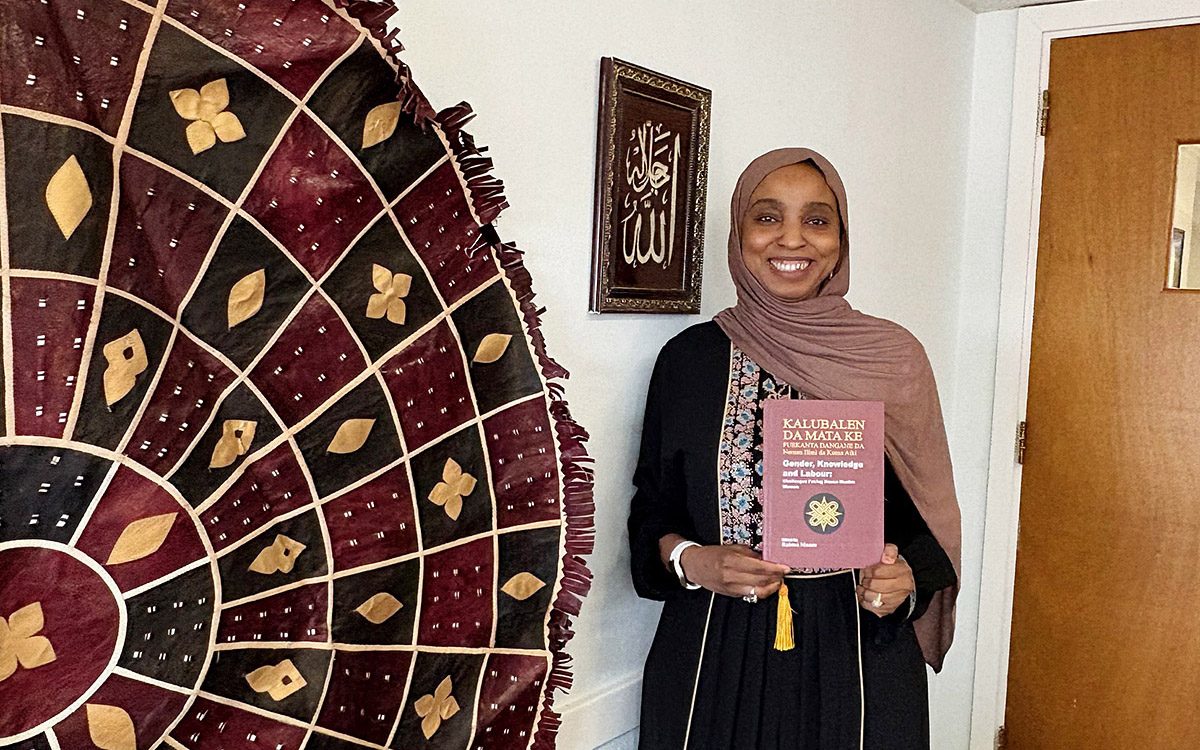
LAWRENCE — Not only is her new book an act of decolonizing knowledge because it is written in her native Hausa language, but the volume by Rahina Muazu is, according to the author, meant to model “a practice of responsible interpretation, grounded evidence and open debate” in Nigeria, where in recent years certain issues around faith, education and gender have been hotly — even violently — contested.
“Ƙalubalen Da Mata Ke Fuskanta Dangane: Da Neman Ilimi da Kuma Aiki” or “Gender, Knowledge, and Labour: Challenges Facing Hausa Muslim Women” (Ahmadu Bello University Press) is the product of an academic seminar Muazu organized in 2024 in her hometown, Jos, in central Nigeria. The University of Kansas assistant professor of African & African American studies edited the open-access book, contributing an introduction and her own chapter — “Shin Ilimin Mace na da Haddi a Musulunci?” or “Is There a Limit? Rethinking Women’s Educational Rights in Islam” — to the 10 other chapters written by seminar participants.
“This is among the very few scholarly collections to present original academic research in Hausa, accompanied by English summaries,” Muazu wrote. “In doing so, the book challenges the entrenched hierarchy that privileges English or French as the languages of scholarship while relegating African languages to the sphere of folklore or everyday speech.”
And while Muazu is quick to point out social inequities facing Hausa women today — even if they are often their families’ major breadwinners — she wrote that “the chapters resist simple binaries — tradition vs. modernity, religion vs. rights — and show how Hausa Muslim women and men are actively interpreting scripture, making families, earning livelihoods and building institutions amid rapid social change.”
The book contains action steps, too: “Several chapters provide concrete recommendations for how educational institutions, workplaces and religious communities might better support women’s participation,” she wrote.
In her own chapter, for instance, Muazu suggested women could enter in a prenuptial agreement entitling them to continue their education after marriage. The KU researcher said she is “fully aware of the limitations of that, because for it to be implemented, the Islamic courts have to be brought into the matter, and there have to be judges willing to enforce it. Hopefully, they will take on that. We'll see if it's able to bring positive changes.”
The book does all this while addressing such culturally important concepts as Qiwamah, which translates as martial authority, and is often interpreted as being the sole dominion of the husband, and Mace ta gari — what constitutes a good and righteous woman.
Muazu said she finds encouragement in reference to Nigerian history and the Yan Taru women’s education movement of the 19th century Sokoto Caliphate.
This period and its leaders are the specialty of Beverly Mack, KU AAAS professor emerita, who contributed a preface to the new book.
“I would say it's a continuation of the work of Muslim scholars — great giants like Amina Wadud, Fatema Mernissi, Leila Ahmed, Asma Barlas. They have been doing that kind of work in different contexts,” Muazu said. “But no one yet has done that in the context of West African Hausa society in the local language of Hausa.”