Scholar sketches a Jewish economic theology
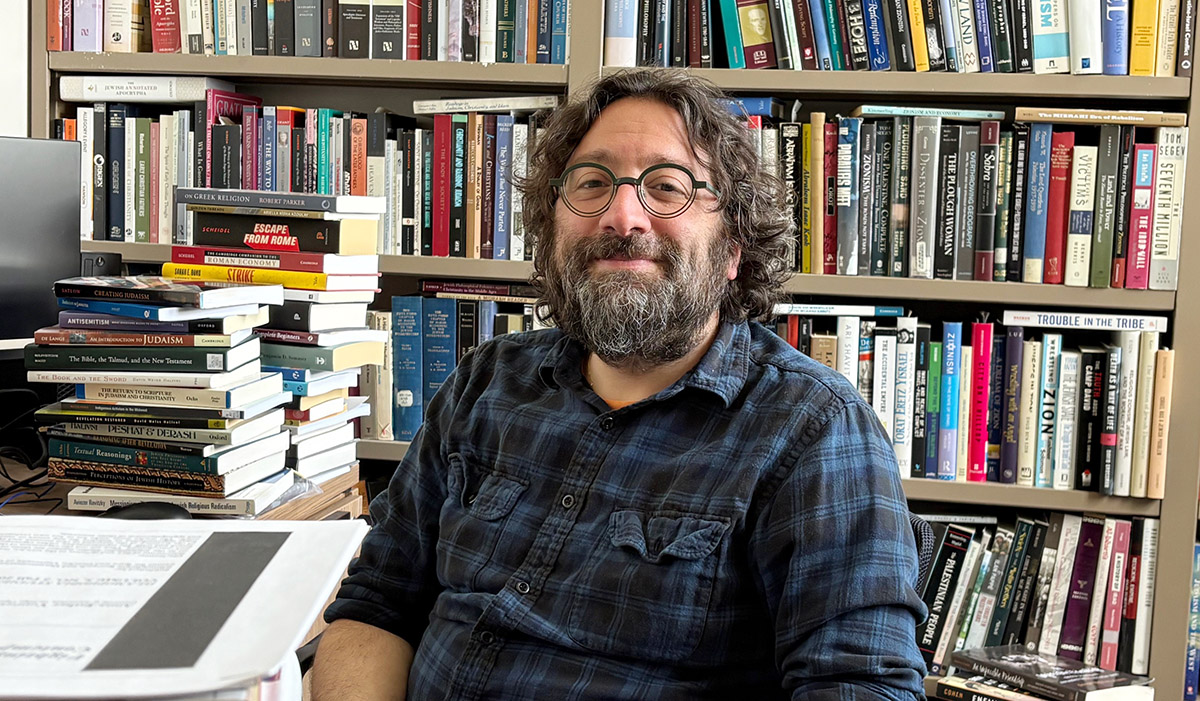
LAWRENCE — Samuel Brody acknowledges that contemporary Jews don’t think much about their faith’s stance on economic matters.
Indeed, that is one reason why the University of Kansas associate professor of Jewish studies and religious studies has taken it up as his field of study, including writing a new chapter on “Jewish Economic Theology” in the ever-growing St. Andrews Encyclopaedia of Theology.
Brody starts with the biblical injunction against lending money at interest and sketches historical Jewish highlights stretching from the rabbis of the Talmud to the medieval sage Maimonides to Karl Marx.
This presents an immediate problem, Brody said.
“The sources that are the most sacred in any tradition are always the oldest,” he said. “The closer you get to the present, the more it’s just some people with opinions, right? But the oldest sources are always developed in economies that don’t resemble this one in any way. So some people like to say Jesus is a socialist, while others say Jesus is a capitalist. But both of those categories are anachronistic when applied to the first-century Roman-Palestinian context.
“So the question is, ‘What do people do to take these sources that are about the ancient world and make them relevant now?’
“I don’t begrudge anyone who says the Torah says that you have to care for the widow and the orphan, and therefore we should support minimum-wage laws. That’s fine. ... But it’s also important to know that in the time that the Torah was received-slash-written, there was no such thing as a minimum-wage law, and no government in the world had ever instituted such a thing. It just wasn’t the mental framework that anyone was operating in.”
Brody said that the Hebrew Bible does put the onus on the wealthy to make accommodations that allow the poor to survive with dignity.
“The Torah addresses people who have, rather than people who don’t have,” he said. “So if you are the one with a field of grain, you are commanded to leave the corner of your field unharvested for the person who is gleaning.”
Brody addresses the efforts of Jewish theologians down the centuries to work around biblical injunctions like the Sabbatical and Jubilee years, when the land lies fallow and debts are forgiven.
“There is a sort of conflict between Scripture and reality, and one attitude that you could have about the Jubilee would be: ‘This is a commandment in the Torah. We therefore need to do everything we can to design society so as to make the Jubilee possible. You can’t just say this is impossible. It’s in the Torah. We’re supposed to do it, right?’
“But the controlling attitude most of the time is that religious authorities look around, they see what people are actually doing, and they think: ‘If I make a ruling that requires everyone to completely change their life, no one is going to listen to me. So I have to make a ruling that will push people in a direction — a couple of steps that they’d be willing to take — and not make myself irrelevant by telling them they have to change their life.’
“Now that changes somewhat in the modern era. ... Marx is telling you to completely change the society around you, rather than just make some small modification. But ... this whole idea that humans can change the society is a modern sort of attitude.”
Brody is also the author of “Idolatry and Time: Capitalism and Money in Twenty-First-Century Christian Economic Theology” (2022) and “Jewish Economic Ethics in the Neoliberal Era, 1980–2016” (2021).