Students in new KU course participate in NATO simulation

LAWRENCE — University of Kansas students recently had the opportunity to participate in a NATO simulation exercise, presented in cooperation with the North Atlantic Treaty Organization (NATO) Allied Command Transformation.
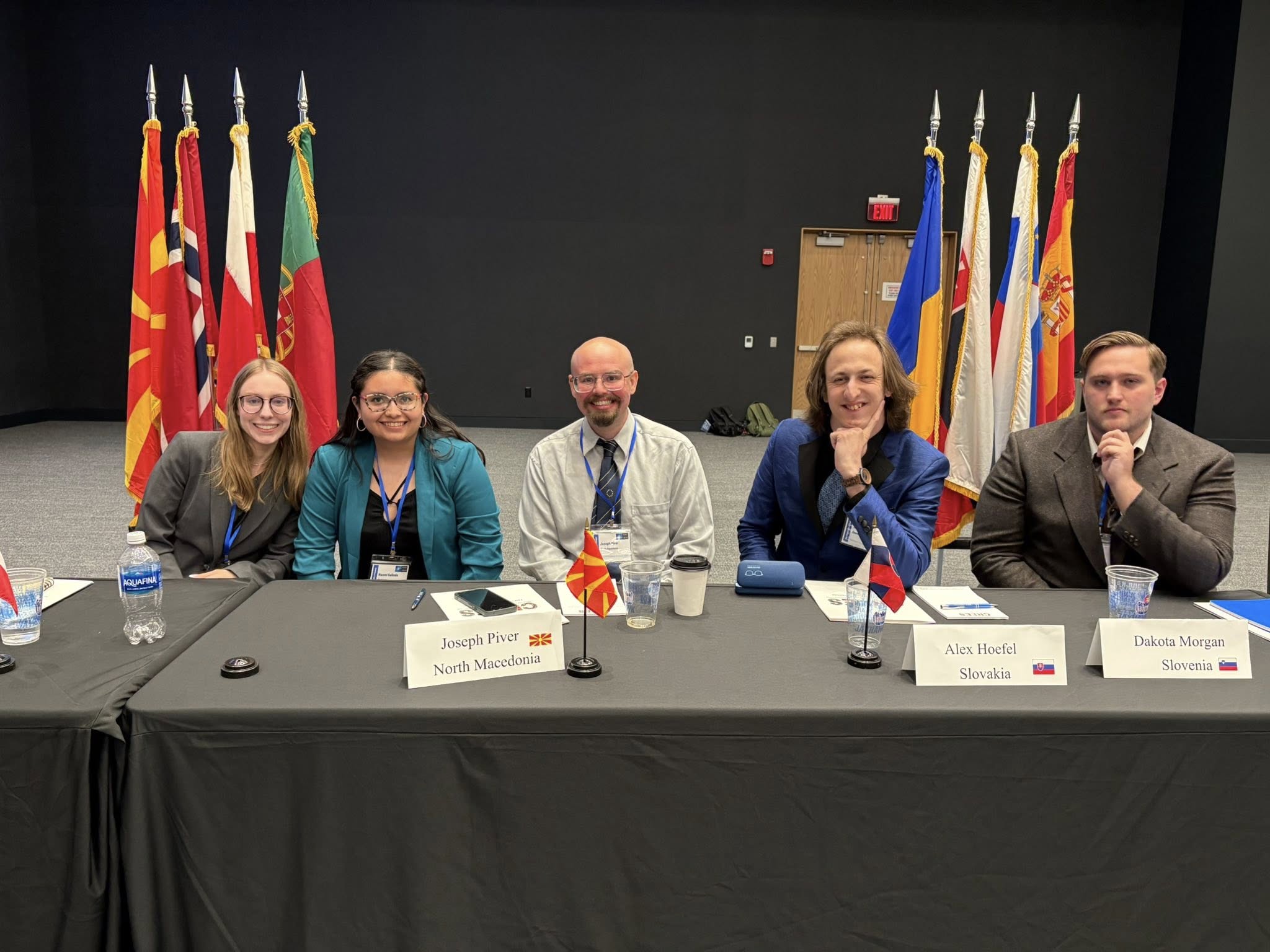
The simulation, which took place May 6 at the KU Conference Center, was the culmination of a semester of work for students in KU’s inaugural Model NATO class, taught by Rebecca Johnston, Center for Russian, East European & Eurasian Studies, and Kurt Preston, National Defense Initiatives. KU undergraduate and graduate students represented each of the 32 NATO nations.
The simulation centered on a fictitious situation in which Russian cyberattacks on water facilities in the Baltic states led a contaminated water supply and some fatalities. NATO ambassadors had to determine if the situation warranted invoking Article 5, the cornerstone of the alliance, in which an armed attack against one member is seen as an attack against all, committing members to collective defense.
The event included welcoming remarks by Col. Mike Denning, assistant vice chancellor, KU National Defense Initiatives; Michael Sfraga, former U.S. ambassador-at-large for Arctic Affairs; and Arash Mafi, KU provost and executive vice chancellor.
Mafi said that he often speaks about “preparing students, not simply for careers, but for citizenship in an interconnected world — one that demands critical thinking, respect for human rights and individual freedoms, empathy, and that values diverse perspectives and the inherent worth of each person through their respective laws, institutions and cultural values. In higher education, we must ensure our students are able to work through difficult problems with others.”
Before the simulation began, NATO ACT representatives Luisa Freutel, academic outreach, and Jay Paxton, corporate and media relations, spoke to the students about what work at NATO is really like, reviewed the rules of decorum for the simulation and explained that communication skills beyond linguistic competence are vital, noting the importance of cultural awareness.
The simulation included discussion between ambassadors moderated by the secretary-general, as well as unmoderated breaks, where ambassadors could continue talks in small groups. The student ambassadors concluded the event by approving a statement which outlined response measures including shared intelligence, humanitarian aid, bolstered NATO presence in the Baltic states and limited cyber offense. The group did not opt to invoke Article 5.
“We asked a lot of them, and the knowledge, tact and professionalism that the students displayed at the simulation showed that they truly rose to the challenge. I couldn't be more proud of how our students performed,” Johnston said.

Students in the Model NATO class, cross-listed in political science, history and Slavic, German & Eurasian studies, prepared for the event throughout the semester. They first learned foundational knowledge required for a basic understanding of multilateral institutions generally and the context of NATO specifically.
“(The class) created something rare, an environment where students engage with international decision-making as active participants rather than passive observers,” said student Ayan Dave.
The course shifted to an experiential learning phase, during which each student was assigned a NATO country and asked to prepare the necessary briefing materials to fulfill their role as national representatives. Toward the end of the semester, the students transitioned into a collaborative phase that emphasized the importance of interaction in the learning process.
“In designing the Model NATO course, we thought holistically about what skills and information students would need to step into the shoes of a NATO ambassador,” Johnston said. “They had to be informed about the history and politics of NATO as well as ongoing debates about the organization.”

The initiative was co-organized by the KU National Defense Initiatives; Intelligence Community Center for Academic Excellence; Center for Russian, East European & Eurasian Studies; Department of Political Science and KU International Affairs.
NATO ACT and KU plan to collaborate for future events like the May 6 simulation.