Study finds Amazon rainforest now releases more carbon than it absorbs
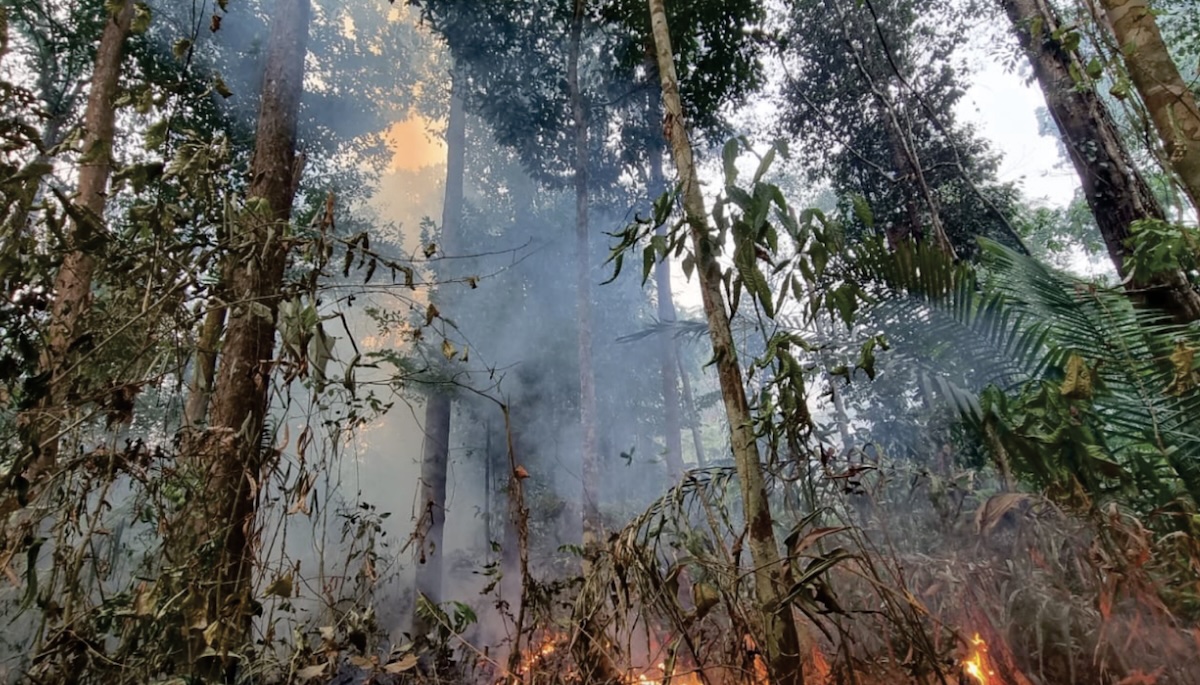
LAWRENCE — The Amazon rainforest in South America is so critical to the health of Earth’s atmosphere that it’s known as the “lungs of the planet.” In part, that’s because the forest’s dense vegetation absorbs vast amounts of carbon dioxide from Earth’s atmosphere, helping to counteract global human carbon emissions.
But in recent decades, the Amazon rainforest has been degraded by deforestation, drought and fires. Now, a new study in Nature by an international team of researchers, including from the University of Kansas, shows the hotter, drier Amazon is a net source of global carbon emissions. Only in the wettest years does the rainforest remain closer to carbon neutral.
The paper, led by Brazil’s National Institute for Space Research, is based on a unique dataset: 15 years of airborne measurements of atmospheric carbon, collected by research planes sampling the air at different elevations above the rainforest.
“Understanding the carbon cycle in the tropics is much more difficult than in the extra-tropics,” said co-author Jen Johnson, assistant professor of ecology & evolutionary biology at KU. “The core challenge is satellites looking top down often have their view obscured by persistent cloud cover, and also there are relatively limited ground-based networks to look from the bottom up. In this context, airborne vertical profiling fills a critical gap, providing the most direct way to quantify the movement of carbon between tropical land ecosystems and the atmosphere at the regional scale.”
The KU investigator and her colleagues used the newest version of the long-term Amazon airborne dataset to look into which processes were most important in determining the Amazon’s net carbon balance.
“We wanted to know, ‘Is the effect of global climate on the Amazon the most important factor determining its carbon balance, or are regional human-driven activities — like deforestation and clearing through wildfires — equally or more important?’” Johnson said. “In this analysis, the team classified each of the last 15 years into one of three groups with different characteristics in terms of climatic stress and the level of human activities occurring in the region.”
The research team found:
- In years that were relatively wet, with little deforestation or wildfire activity, the Amazon was still a small net source of carbon to the atmosphere.
- In years when the climate was relatively mild, but with high levels of deforestation and wildfire activity, net carbon emissions jumped dramatically, corresponding to the increase in human activities at the surface.
- The third group was the worst of all: years with severe climate stressors that led to extreme droughts in the region, coinciding with very high levels of deforestation and burning at the surface.
“In combination, those drivers led to almost the same level of net carbon emissions to the atmosphere as the second group of years, when the climate was relatively mild,” Johnson said. “The conclusion from that comparison is that human drivers of land-use change are the dominant control on the Amazon’s net carbon balance. Global climate and climate-mediated stressors are important modulating factors, but people’s choices about how to use and live on the land surface in this region are key to understanding the movement of carbon between the land and the atmosphere.”
The KU researcher, who helped conceptualize and write the paper, said the findings should inform policymakers and conservationists as well as climate scientists and biologists.
“There’s a clear, policy-relevant prescription that comes from this analysis,” she said. “Measures to bring deforestation down to zero are required to manage net carbon emissions from the Amazon. There’s a very real and important opportunity to manage Amazonia’s carbon budget. It’s not something that’s out of our control because it’s being driven by global climatic factors — it’s something very much under the control of governments and individuals.”
Failure to act would mean a further reduction in the rainforest’s ability to absorb carbon from the atmosphere, with global consequences.
“For many decades, there has been concern about the idea of a tipping point, where gradual drying and gradual loss of the forest could feed back on itself in a self-reinforcing way,” Johnson said. “That could create a transition from an ecosystem type that has stored huge amounts of carbon in living vegetation to drier forests or other ecosystem types that do not store nearly as much carbon. The more carbon from the Amazon that moves into the atmosphere and stays there, the more trouble our climate system is in.”
The investigators found 2024 was the most severe year for carbon emissions from the Amazon.
“That year fell into our Group 3 category, where we had the coincidence of really warm temperatures, very low precipitation and high rates of fire-driven deforestation,” Johnson said. “That cocktail of events led to massive carbon emissions into the atmosphere. Looking back at our time series, that was the year with the single highest annual emissions.”
Going forward, Johnson said she hopes to integrate additional measurements into the airborne monitoring program.
“Looking to future, what we hope to do is to unfold all the different components of the exchanges of carbon that contribute to the net carbon balance,” she said. “It’s actually really hard to understand why the net carbon balance fluctuates from year to year unless you can reliably quantify the underlying gross fluxes in and out of the atmosphere. We’re collaborating on efforts to bring new trace gases into the monitoring program that would help us with this partitioning and process attribution, to be able to define with much more accuracy and precision the components of the net carbon budget.”
Johnson's co-authors were lead author Luciana Gatti of the National Institute for Space Research and the Nuclear and Energy Research Institute in Brazil; Camilla Cunha, Juan C. G. Blas, Mariane Reis, Luciano Marani, Egidio Arai, Cassiano Gustavo Messias, Vanúcia Schumacher, Kleber Naccarato, Luciana Soler, Claudio Almeida, Caio S. C. Correia, Raiane A. L. Neves, Alber Sanchez, Francine da Silva, Vagner Camilotti, Christiane Silvestrini, Filipe Loyola Lopes, Marcio Malacarne and Guilherme B. M. Machado of the National Institute for Space Research; Lucas Gatti Domingues of the Nuclear and Energy Research Institute; A. Scott Denning of Yale University; Dhemerson Conciani and Ane A. C. Alencar of the Amazon Environmental Research Institute; John Miller, Xin Lan and Gabrielle Pétron of the National Oceanic and Atmospheric Administration; Jose Marengo of the National Center for Monitoring and Early Warning of Natural Disasters in Brazil; Carlos Nobre of the University of São Paulo; Sergio Corrêa of Rio de Janeiro State University; Elliott Campbell of the University of California, Santa Cruz; and Joseph Berry of the Carnegie Institution for Science.