Study reveals cosmic tug-of-war behind the Crab Pulsar’s zebra stripes
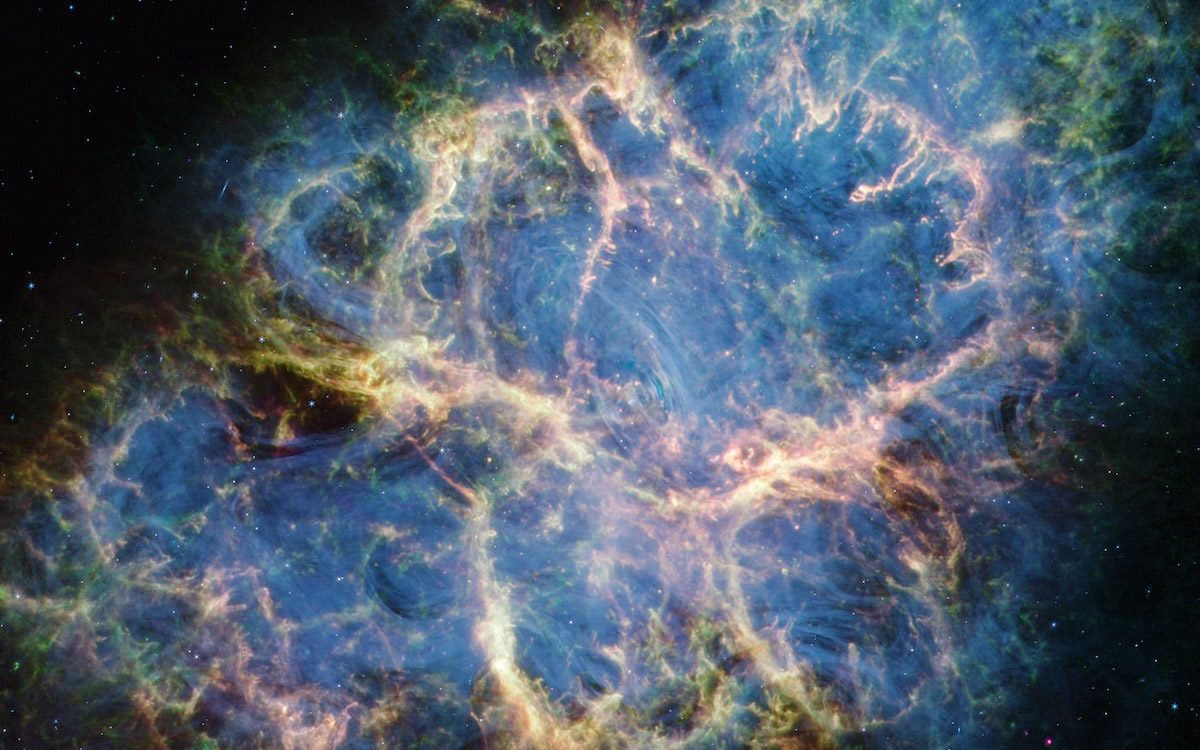
LAWRENCE — For the past two decades, scientists have wondered about a bright, distinct striped pattern seen in radio waves emanating from the Crab Pulsar, the remnant of a supernova observed by Chinese and Japanese astronomers in the year 1054.
In 2024, a contemporary theoretical astrophysicist from the University of Kansas published work largely solving the mystery of its zebra pattern, but now he has fine-tuned his analysis, finding gravity’s lensing effects to be the last piece of the zebra-stripe puzzle.
“Gravity changes the shape of spacetime,” said Mikhail Medvedev, KU professor of physics & astronomy, who will present his findings at the American Physical Society’s 2026 Global Physics Summit taking place March 15-20 at the Colorado Convention Center in Denver.
An associated paper has just been published in peer-reviewed Journal of Plasma Physics.
“Light doesn’t travel in a straight line in a gravitational field because space itself is curved,” he said. “What would be straight in flat spacetime becomes curved in the presence of strong gravity. In that sense, gravity acts as a lens in curved spacetime.”
According to Medvedev, while gravitational lensing has been discussed extensively in the context of black holes, this is the only case where astronomers see a “tug-of-war” between plasma and gravity shaping the observed signal.
“In black hole images, gravity alone shapes the structure,” he said. “In the Crab Pulsar, both gravity and plasma act together. This represents the first real-world application of this combined effect.”
Relatively close in astronomical terms, the Crab Pulsar is centered within the Crab Nebula, located in the Perseus Arm of the Milky Way galaxy — only about 6,500 light-years away from Earth with a good line-of-sight. Because it’s nearby and easily observed, study of the Crab Nebula and Crab Pulsar gives astronomers insight into nebulae, supernovae and neutron stars in general.
“There’s a remarkable pattern in Pulsar’s spectrum,” Medvedev said. “Unlike ordinary broad spectra — such as sunlight, which contains a continuous range of colors — the Crab’s high-frequency inter-pulse shows discrete spectral bands. If it were a rainbow, it’s as if only specific ‘colors’ appear, with nothing in between.”
Most pulsar radio emissions are spectrally broader and noisy, not banded so cleanly like the Crab Pulsar.
“The stripes are absolutely distinct with complete darkness between them,” Medvedev said. “There’s a bright band, then nothing, bright band, nothing. No other pulsar shows this kind of striation. That uniqueness made the Crab Pulsar especially interesting — and challenging — to understand.”
While earlier Medvedev’s model could reproduce stripes, the high contrast of the bands actually observed in the Crab Pulsar couldn’t be accounted for. Indeed, his research recently determined the Crab Pulsar’s plasma matter causes diffraction in the electromagnetic pulses largely responsible for the neutron star’s singular zebra pattern.
But now Medvedev has factored in Einstein’s theory of gravity into the mix, finding it plays a pivotal role in the Crab Pulsar’s zebra pattern.
“The previous theoretical model could reproduce stripes, but not with the observed contrast. The inclusion of gravity provides the missing piece,” Medvedev said. “The plasma in the pulsar’s magnetosphere can be thought of as a lens — but a defocusing lens. Gravity, by contrast, acts as a focusing lens. Plasma tends to spread light rays apart; gravity pulls them inward. When these two effects are superimposed, there are specific paths where they compensate each other.”
The KU researcher said the combination of a defocusing magnetospheric plasma and a focusing gravity create in-phase and out-of-phase interference bands of radio-wave intensity that appear as the Crab Pulsar’s zebra stripes.
“By symmetry, there are at least two such paths for the light,” he said. “When two nearly identical paths bring light to the observer, they form an interferometer. The signals combine. At some frequencies, they reinforce each other (in phase), producing bright bands. At others, they cancel (out of phase), producing darkness. That is the essence of the interference pattern.”
The KU researcher said he’s satisfied the mechanism for the observed zebra pattern now has been almost fully explained.
“There appears to be little additional physics required to explain the stripes qualitatively,” Medvedev said. “Quantitatively, there may be refinements. For example, the current treatment includes gravity in a static, lowest-order approximation. The pulsar is rotating, and including rotational effects could introduce quantitative changes, though not qualitative ones.”
The KU researcher said the work may allow scientists to probe rotating gravitational objects more directly. Further, the new understanding could lead to a new grasp of pulsars in general, which are small and difficult to represent visually. It also presents a unique test ground for the pulsar theory and simulations. The model can also be a sensitive tool for the matter distribution around neutron stars and possibly even probe their interiors via its gravitational effects.
This work was supported by the National Science Foundation (NSF) under grants PHY-2409249 and in part PHY-2309135 (the latter is to the Kavli Institute for Theoretical Physics).