Study shows athletes with better jumping ability generate faster golf club head speed
LAWRENCE — There is an old saying in golf that you drive for show and putt for dough. And if you want to have drives that put on a big show, you must have good club head speed. New research from the University of Kansas is helping determine what physical characteristics correlate with elite club head speed and how athletes can further develop them.
Tall, lean athletes tend to have better club head speed. And while jumping and golf might not normally be associated, research shows that athletes capable of jumping higher, farther and with better lateral jumping ability also tend to generate faster swings. Through the study, researchers also developed golf-specific load velocity profiles that coaches and trainers can use to help athletes improve.
“Sport science in golf is extremely rare. But the opportunity to help golf athletes presented itself, and we wanted to take it and see what we can do to help athletes improve club head speed,” said lead author Quincy Johnson, assistant professor of health, sport & exercise science and assistant director of the Jayhawk Athletic Performance Laboratory. “We found there are key performance indicators. It’s simple: Height and weight are related to club head speed. So is the ability to create power.”
For the study, researchers worked with 21 golfers, 11 female and 10 male, from Oklahoma State University. An elite program, OSU’s men’s program won the 2025 men’s national championship and has 12 all-time titles.
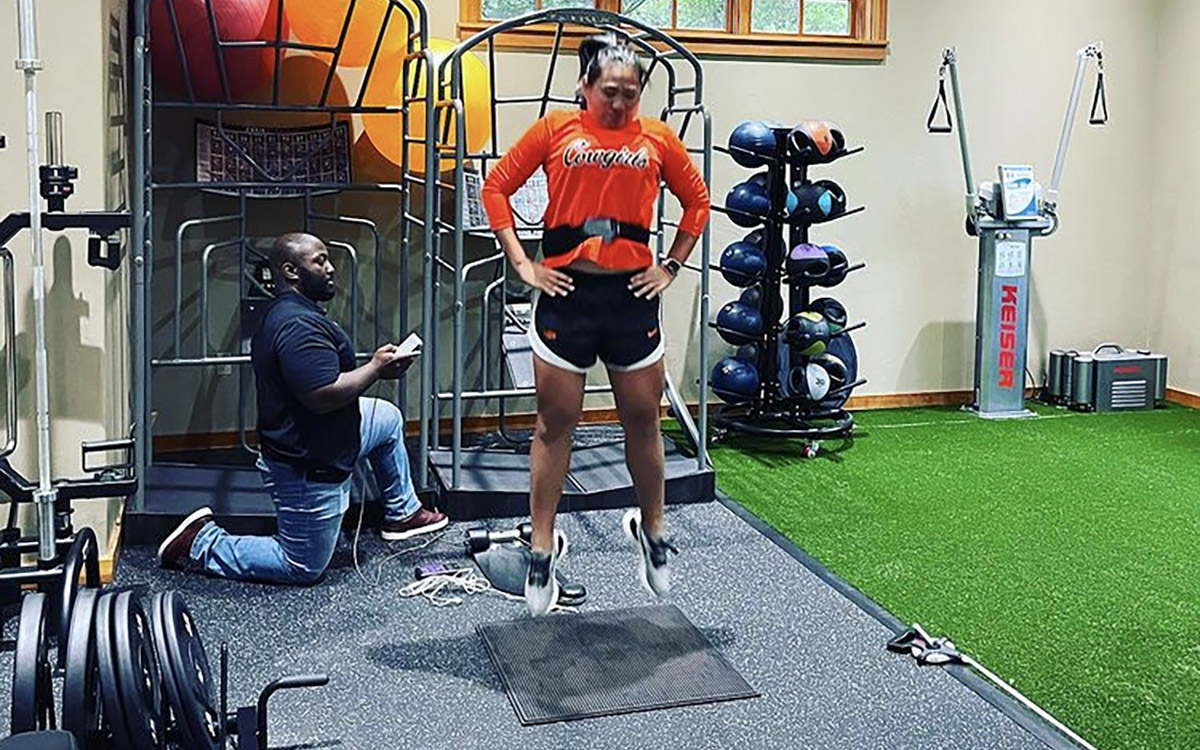
All the athletes’ height and weight were measured, and their normal and fast club head speed on drive swings was measured as well. They were also tested on jumping ability, with measurements taken for vertical jumps. The golfers also were tested for lateral jump abilities, in which they stood in a stance similar to that when taking a tee shot and jumped as far as they could sideways.
Results showed that taller, leaner athletes generated the highest club speed and that the better jumping ability was also correlated with club speed. Measurements such as shoulder range of motion and hip range of motion were not correlated with club speed.
Another novel aspect of the study was the development of golf-specific load velocity profiles. The approach is commonly used in power sports such as football and rugby, but not with golf.
The research team measured the athletes’ upper body rotational power by using a machine similar to those used for cable lifts. Golfers conducted a simulated swing with a strap positioned over the shoulder and across the waist. Tension on the cable was set at 12 %, 15% and 18% of body mass. The athletes that generated the highest rotational velocity at each setting correlated with greater club head speed.
Taken together, the findings can help athletes, coaches and trainers develop plans to improve the physical training of athletes. Focusing on exercises such as squats that help develop jumping ability and using exercises that build lean mass can be essential to developing the characteristics that correlate with club head speed.
“If you are an athlete, coach or sports performance professional who wants to improve club head speed, this paper highlights how vertical jump and rotational velocity may help contribute to that,” Johnson said.
The authors recommend utilizing an evidence-based resistance training approach that is designed to improve strength-endurance, neuromuscular strength and neuromuscular power, which may translate to upper-extremity rotational velocity, clubhead speed and overall athletic performance.
The article, written with Yang Yang and Andrew Fry of KU and Kira Ziola, Dawei Sun, Jonathan Moore, Paige Sutton and Douglas Smith of Oklahoma State University, was published in the International Journal of Strength and Conditioning.
Johnson, who has published research into characteristics such as strength differences by position in football, elbow and ulnar collateral ligament thickness in baseball and performance indicators in other sports, said he hopes to continue research into other measures of golf performance.
As any golfer will tell you, driving is only one part of the game, but the study’s findings can help good golfers become great and great golfers elite, beyond natural characteristics like height.
“Is there a physical prototype for the best golfers? I’m not sure we can say that, but this does give insight into how we identify strength and how to come up with plans for improvement in an important aspect of the sport,” Johnson said.