Witnessing service workers being treated poorly inspires bigger tips, study finds
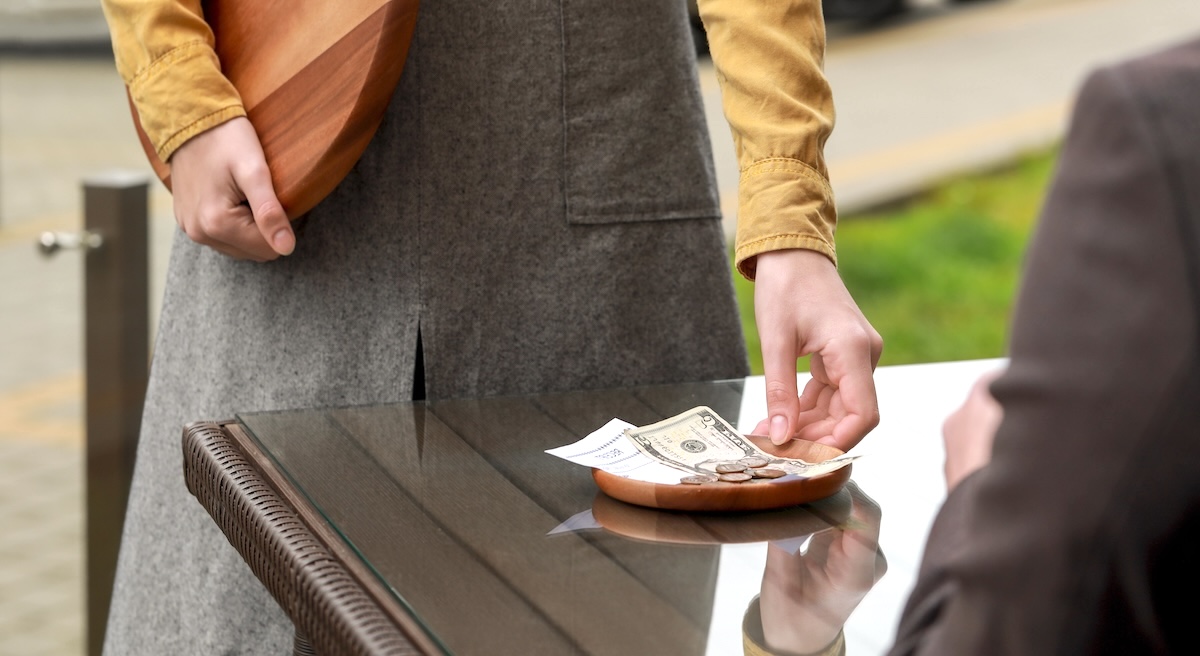
LAWRENCE — An adage called the “waiter rule” states you can tell an individual’s true character by the way they treat service workers.
“It’s a situation where you’re not obligated legally to tip them or treat them well,” said Jonathan Beck, assistant professor of marketing at the University of Kansas. “But how you treat them signals who you are as a person.”
Beck has put that adage to the test with a new article titled “Witnessing Consumer Incivility Toward Service Employees: Pity, Support, and Tipping Behavior.” Drawing from social exchange theory, he finds that witnessing incivility leads to feelings of pity, followed by increased emotional support and, ultimately, an increased tip for the target employee. The article is published in the Journal of Service Research.

With an estimated 79% of employees in the United States working in the service industry (according to Statista), the American system of tipping offers a particularly unique environment. This comes with its own set of standards and expectations.
“Everyone is around everyone else, interacting and seeing what service other customers get,” said Beck, who co-wrote the article with Sarah Lefebvre of Murray State University and Clay Voorhees of the University of Alabama.
“It’s not isolated. That makes people inherently have direct and indirect social exchanges with people they don’t know.”
This cultural setting provides a context for sharing the emotional experience of others.
Beck said, “If you see a server treated uncivilly by another customer, which is defined as low-intensity rudeness — it’s more subtle than actions such as anger or something like screaming — we feel pity for the server being treated badly and want to support them within this environment.”
Most often that support doesn’t come in the form of direct intervention or confrontation. Instead, it manifests through tipping, according to the researchers.
To study this hypothesis, Beck’s team recruited more than 1,200 participants across three studies comparing experimental conditions that manipulated the incivility (vs. control or civil conditions) that the participant observed from another customer. The participants watched different videos featuring customers who were being civil or uncivil and servers who made a mistake or didn’t make a mistake.
The study revealed that a regular tip was 17% in a “normal” situation and 20% when witnessing incivility. Thus, waitstaff providing adequate service saw a 3% increase.
An important thing to note was the tipping amount still depended on the quality of service the customer received, Beck said.
“If a server is being treated uncivilly, but they give you really poor service, you may feel bad for them, but you don’t necessarily tip them more,” he said.
The impetus for this paper came during the COVID-19 pandemic.
“Everyone was crazy for all sorts of different reasons, and I was noticing people being rude to service workers. These employees aren’t trained to deal with 20 customers coming in who don’t want to keep their masks on or wonder why they must sit far apart from others or why there’s no stock in the shelves because of the supply chain. I figured that if I see someone treated poorly, I can make them feel a little better by giving them a few extra dollars. Then I started wondering, ‘Does this apply to everybody, and why?’” he said.
Beck said what surprised him the most was how the bystander effect (which proposes individuals are less likely to offer help to a victim in an emergency — such as witnessing a heart attack — when others are present) had little impact on the results.
“Some of the prior literature claims the bystander effect will buffer it because everyone thinks someone else will compensate with an increased tip. But we accounted for that and tested for that, and despite what a lot of participants were witnessing, people still felt the need to help,” he said.
“My best guess why the bystander effect didn’t hold is that you don’t see what other people are tipping — versus you do see if someone is giving CPR.”
Now in his fifth year at KU, Beck focuses his research on services marketing and digital marketing. When it comes to tipping, he said he defaults to 20%. But like most people, he will give a few dollars more for good service and a few less in “worst-case scenarios.”
“This is an interesting implication for the research because it’s almost a paradox where employees who are treated poorly get tipped more. But I don’t think employees necessarily want to be treated this way,” Beck said.
As for how managers and owners of businesses should incorporate these findings, Beck said he hopes they take a holistic approach.
“They need to pay more attention to the whole environment, all the customers and how everyone’s interacting,” he said, “rather than just trying to focus on the staff getting food out and offering good service.”