Perilous partnership among gender, violence, military scrutinized in new book
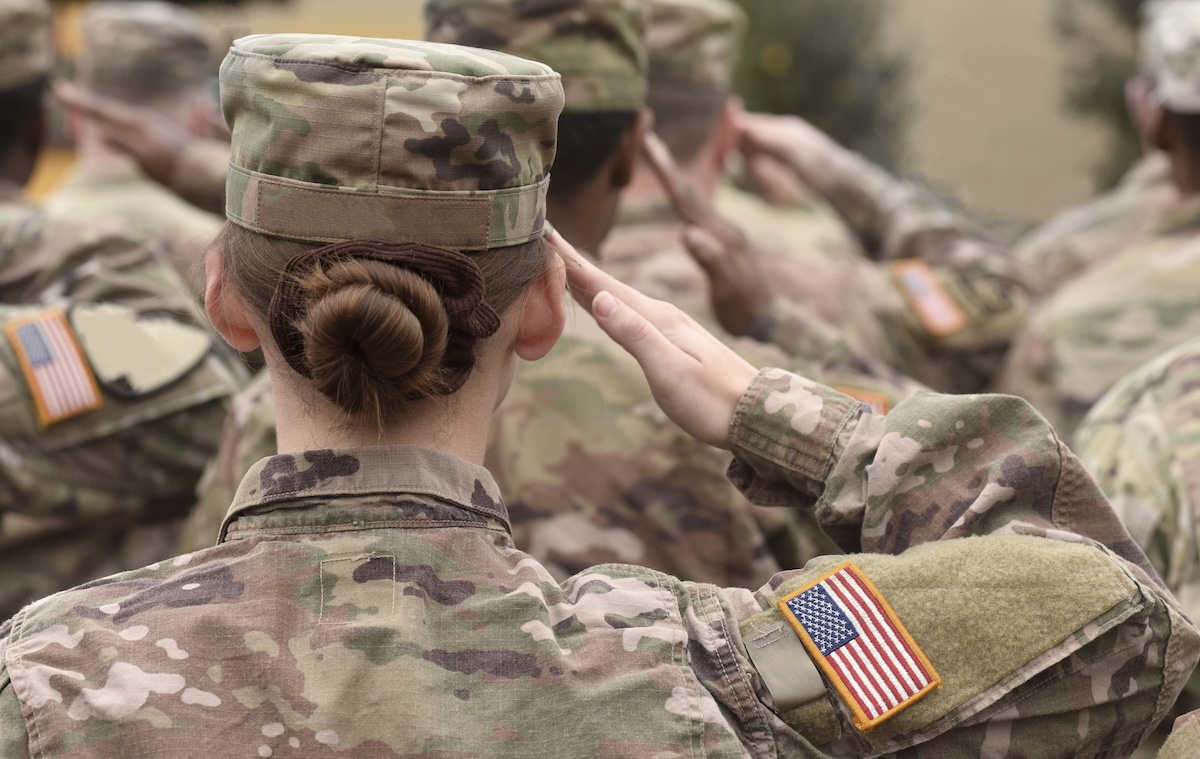
LAWRENCE — President Dwight D. Eisenhower famously coined the concept of the military-industrial complex.
But one University of Kansas professor has introduced an equally intriguing concept: the military-sexual-gender-complex.
“There are all kinds of ways to think about the intersection of gender, sexuality and violence in the military,” said Joane Nagel, University Distinguished Professor of Sociology. “This is a critical libidinal infrastructure for war.”

Her chapter titled “Gender, Violence and the Military” strives to sort out this complicated relationship. It appears in the “Handbook on Gender and Violence,” which gathers a collection of experts who interrogate the relationship among these titular subjects. The book is published by Edward Elgar Publishing.
Nagel said the influence of gender in shaping military culture, organization, expectations and functioning cannot be overstated.
“The military is a really problematic institution,” she said.
“It emphasizes some of the better qualities of people: helping each other, camaraderie, unity, being part of a group. And it also emphasizes some of the worst characteristics: cruelty, territorial defense, murder, glorification of violence, xenophobia and an ‘us versus them’ mindset.”
She said that last year’s executive order to turn the Department of Defense into the Department of War magnifies such negative qualities.
“War isn’t defense. War is offense,” she said.
For the most visible example of the military-sexual-gender-complex, Nagel mentioned the Iraq War.
“With the Abu Ghraib scandal of 2004, you realize that women became tools of the U.S. military to interrogate, humiliate and discipline Arab/Muslim men,” she said.
“But women soldiers were also very useful to the military because they could enter spaces where Arab men might have resisted having a man go, for instance, into secluded ‘purdah’ spaces. Yet a woman soldier could be allowed in. Women are not only useful in many military operations and in humiliating enemy soldiers, as in the case of the Abu Ghraib, but also as sexual partners … sometimes willingly, but often unwillingly.”
She wrote that the growing presence of women in uniform has created a new set of opportunities for gendered military violence. Her chapter explores institutionalized patterns of sexual harassment and rape within the armed forces and the militarization of rape in war.
“I don’t know whether the Trump administration is going to continue to study sexual assault in the military — even though a report came out this year,” she said.
“Right now it’s much worse for women in the military because of the current administration’s hostility and skepticism toward women in uniform. Before Trump’s election it was getting better, with women being allowed into combat, which is one of the ways you advance in rank. Women officers were increasing, and enlistment had gone way up since 1970.”
The impetus for Nagel’s research sprung not from the modern military but from a bygone one.
“I was watching Ken Burns’ series, ‘The Civil War,’ and I kept wondering, ‘Why are these Northern boys who don’t know a thing about Southern racism enlisting to fight some war in Alabama or wherever? What were they thinking?’” she said.
Nagel said she came to the realization that men’s involvement in the military is connected to masculine traits, like bravery, adventure, duty and patriotism — and how the intersection of masculine culture and nationalism creates the conditions under which men become involved. Sometimes not to do so is seen as cowardice or shirking duty.
“If you ask a man what the worst insult he can be called is, it’s going to have something to do with cowardice,” Nagel said. “For women, it’s something that involves sexual purity. And that balance plays out in the military, which has a long, storied history of being dominated by men — almost exclusively, given few exceptions.”
Nagel has been a faculty member at KU since 1977, and she will be retiring to emeritus status at the end of the month. While her career has produced research in many areas, she has recently focused more on environmental sociology. Her book “Gender and Climate Change” (Routledge, 2015, second edition 2026), posits that policymakers who embrace big science, sometimes militarized solutions to climate change are predominantly led by men with an agenda that marginalizes the interests of women.
“Militarism is a dangerous path to go down,” Nagel said, “what with the glorification and the building up of the military in terms of manpower and the amount of the GDP that we are putting into this murder machine and sexual assault machine. Sometimes you need it for defense, but the takeaway is: Be very careful of militarization of science, of politics, of everyday life.”